Wednesday, 26 November 2014

6 self potrait artists

Kathy Kolwitz


Kathy Kolwitz is an artist who mainly works with graphite and charcoal pencils and does self portraits of herself portrayed differently, Kolwitz is a jewish woman whom survived world war two and the holocaust and a lot of her work portrays some raw emotion which she had felt throughout that stage in her life.

Phillip Guston


Phillip Guston is an artist whom paints himself in surreal ways, his work signifies his addiction to alcohol which he has had since a young age and what it was like for him to get over it, I like the way in which he paints quite comically but this however contrasts the seriousness in which it affected his life.

Ken Kiff


Ken Kiff is a figurative artist and was brought up when abstract art was becoming a big thing, so this influenced him a lot, resulting in his paintings and other art work to look almost dream like and like that of a child's fantasy tale.

Guy Denning


Guy Denning is an self portrait artist whom uses mediums of paint, charcoal , pencils and collage within his work. Denning is one of my favourite artists due to how with only a few powerful lines amongst some smudged colours he can effectively grasp the figures emotions and gives a huge amount of detail.

Bryan Lewis Saunders


Bryan Lewis Saunders is an experimental artist and he set out to give himself unique factors whilst painting unlike other artists, for his self portrait series of work he gave himself multiple drugs, each painting he is under the effect of something different, this series of work I found to be extremely amazing due to all the different styles he achieved. Showing that artists may perceive things differently depending on the way they feel and the chemicals in their brain.

Francis Bacon


Francis Bacon is an artist whom manages to show a lot of raw power and emotion with his paintings, often isolating his figures in cage like shapes and using dark colours, he became renowned as one of the most influential dark and gothic artists. His self portrait of himself shows his face to be twisted, perhaps signifying that he sees the world in a different way from others, at the time bacon was a closeted homosexual so this might have had some relevance.

6 landscape artists

Ansell Adams


Ansell Adams explores american locations and uses a slow shutter speed to capture more movement among the clouds and water in lakes, he is also a great photographer and has an amazing eye at capturing good depth of field and positioning his shots, his photographs include a lot of power and detail from the amazing views that he represents through the digital images.

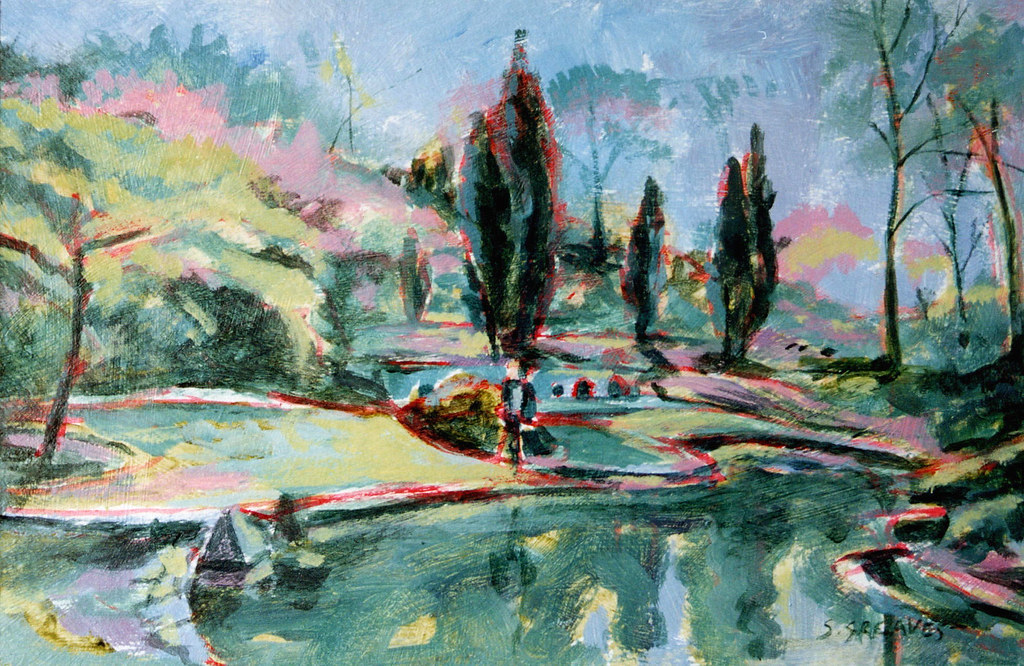
Steve Greaves


Steve Greaves uses quick brush strokes and barely goes over and blends his paint allowing his art to look quite abstract but still clear as to what it is, I find his best work to be those with a blue colour scheme with outlines of red spread around some of the hills and trees that give it an edge and makes it much more aesthetically pleasing due to the contrast.


Peter Lancaster


Peter Lancaster uses water colours to paint landscapes which include water as he paints whilst fishing, I find that a lot of his paintings have parts which are painted in a lot of detail and other parts seem quite monotone and bland in comparison, this allows the audience to maintain its attention on more parts than others , his use of reflection and shadows I find to be very good also on his work.

Rafal Olbinski


Rafal Oblinski entwines both landscapes and dream like thoughts in his work, often making it so that models are affecting the landscape and making it fit to their needs rather than accepting it for what it is, my favourite piece of his works involves a dead forest with a woman who had climbed a ladder and changed the scenery to that of an ocean with a singular tree in it, this surrealism is very intriguing to what it could signify and what aim the woman had and what she could be thinking about, and I find work that is thought provoking to be more interesting to view.

Katherine Norris


Katherine Norris is an landscape artist whom uses quite dark and pale colours as a base colour and then layers slabs of bright colours in contrast as the leaves and parts of grass which makes her paintings look divided between and attracts the audiences gaze at only specific parts of the work.

Cathy Horvath


Cathy Horvath uses natural colours however uses extreme versions of them making them stand out and add a lot of vibrance and light to her art. My favourite parts of her art work is when she paints water and uses the reflection of clouds over the surface as it reminds me of old Japanese artwork which is done on paper and outlined with a simple yet effective appearance.

6 Urban land scape artists

Six urban landscape artists whom caught my interest were Georgia O'Keeffe, Jenny Holtzer, Katherina Grosse, Leo Verhoeven, Katherine Lubar and Patrick Cornee.

Georgia O'Keeffe - Radiator building


This is a painting by O'Keeffe which is very art deco style, her work is very interesting especially with the contrasts of that between the dark building which blends into the dark blue background but still distinguishable and that of the white windows of the building.


Her other work also takes the style of art deco, she mainly paints flowers or buildings and uses quite a linear style.

Jenny Holtzer


Jenny Holtzer is an artist whom projects sentences over buildings usually in a political or philosophical ways and photographs the outcome, usually in black and white which allows the text to stand out more with the backgrounds and this allows the audiences eyes to focus on the message.

Katherina Grosse


Katherina Grosse treats the insides of buildings, such as staircases, flooring and walls as canvases that she paints with spray paint and the result is very vibrant and colourful designs that are very eye catching that clashes with its environment.

Leo Verhoeven


Leo Verhoeven paints urban landscapes in a very abstract way with use of straight shapes and monotone colours, the simplicity and repetitiveness of his art is surprisingly detailed for what is actually being shown and even with the wrong use of colour being used on different things it is still easy to see what is what.

Katherine Lubar - Falling up the stairs


This piece of art work is composed of just two colours, white and a deep red and is painted in a very abstract and art deco pattern composed of straight lines and using angles to get an accurate portrayal of how the shadows are shown on the stairs.


Other work by her has the same style, with the basic outline of the shapes and monotone colours used to fill them, this leaves the objects outline to be the main visual attraction, allowing you to take in the work easier and enjoy how the colours co-operate and clash with each other.

Patrick Cornee


Patrick Cornee uses very bright colours which contrasts with the darkness of the shadows and is an interesting artist due to how he puts his own abstract twists of the shapes of the things he paints but not in such a way that it looks much different than usual. He manages to make his work look quite gothic and eery in certain aspects due to the crookedness and twisting movements he gives his objects.

Thursday, 20 November 2014

Artist Books

Lionel Murcott


lionel's artist book DSC02332


I found this artist book by Murcott to be interesting in the way he quickly uses watered down paints to cover pages and sticks down images on top of them, I find the use of colours to be vibrant and stands out when contrasting with the blacks used.


Tullet


2013-10-22-HTTHEBIGBOOKOFARTopen3.jpg


Tullets artist books I find to be very interesting due to having multiple pages painted on in patterns and then cut out and stuck together, leaving intricate sharp patterns which contrast well with each other and still leaving white areas gives an unique feel, I will be influenced on mixing pages and cutting pieces out from this.


Kyle Kirkpatrick


I found the way that Kirkpatrick to turn his book into a sculpture to be very interesting because of how it could represent hills, harbour or even a coastline which would be a great representation of my urban landscape module.

Kim Gordon


I like the idea of sticking down old newspapers and other items and painting over that, giving the work an appearance of time and date and adding different elements and mediums to the work,
 I will take inspiration from this by sticking differnet things with significances to my work over the pages and painting over that.


Christian Faur


Christian Faur specialises in crayon work and I found the way that he uses colours almost like a language with different colours making different words and it being set out like a paragraph with words to be intriguing. I will be influenced by him by setting my book out in certain aspects like a book but changing small things to give it a quirkiness, like colours instead of words for example.

Friday, 7 November 2014

Newcastle art events and possibilities

art galleries/ museums;
-Laing Art Gallery
-The biscuit factory
-F stop gallery
-Opus Fine art
-Lazaride

In 2012, Newcastle announced that it would end its funding for all arts organisations and replaced it with an open application fund called the 'Newcastle Culture Investment fund'

The biscuit factory in newcastle is a large warehouse styled building with a wide range of contemporary art designs for sale by hundreds of different artists, it also houses a cafe and restaurant so would be suitable for a day out visiting.

Lazarides is located in newcastle and is a gallery celebrating urban art work and is acclaimed for being unbounded from traditional art. The gallery is seeking to promote forward thinking artwork from a diverse collection with different talents.

The F stop gallery is a contemporary photography gallery located within newcastle

Mima Review- Winifred Nicholson, Window-sill Lugano 1923


This piece of art in the Mima gallery by Winifred Nicholson had caught my eye due to looking similar to a piece of work which I had previously painted, due to the window view in the background and objects in the foreground.

I am particularly fond of the use of capturing both still life and landscape, capturing both the ever changing element and that of everlasting and non moving objects unless manually moved.

Her mark making is almost primitive in the way that not a lot of detail is shown amongst the flowers, but there is enough difference in tone and colour to indicate to the audiences where there is less light and how each plants differ from one another.

I am also interested in the way her paints appear to have cracked in the background, which to me gives a mosaic like appearance and a mix of the mediums, whether it was deliberate or due to ware over time I believe that it adds a lot of atmosphere and experience to the painting, showing that it stood the test of time.

From my point the image shows that the flowers are more or less looking out to the window, which I think is unusual due to if it was just a normal flower painting, the most aesthetically pleasing part of a flower is the petals which would be more interesting if they faced toward the audience, but instead they are looking out. Giving me the impression that this is supposed to signify them as living and actually enjoying their life in peace by watching the world go by fast and ever changing, whilst they have to stay positioned and just watch.

To me, the flowers are also all different which I believe could be a comparisons for humans,and how we, instead of finding the similarities between each other only look for differences, such as race and gender, whereas the flowers don't care and in the end are enjoying the small stuff in life together which the vast majority of people can't comprehend because wars,money and politics over trivial matters seem ever more important, and that surviving and gaining materialistic objects is more important than 'living'.

The use of colours I find to be very interesting and appealing, the use of soft and mellow reds and yellows contrast well with the strong and dark clash of the blue, which is placed nicely in the middle and background more so towards the left, and also very strongly in a flower on the right, which makes the audience scan the canvas rather than focus solely on one spot. The placement of the blue flower also interests me as it looks like it is using the golden sector rule and being put in a 1:1.6 ratio from the rest of the page.